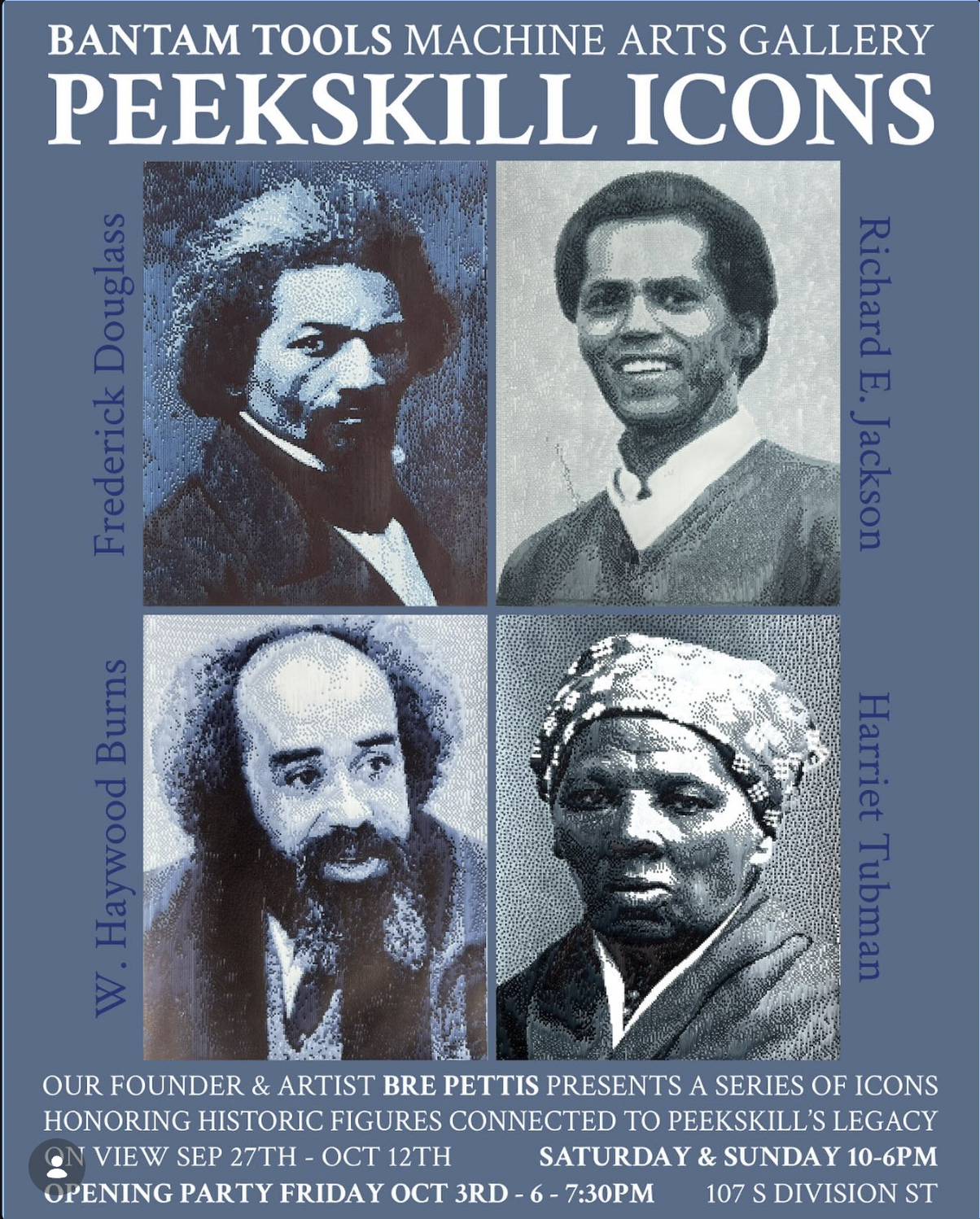
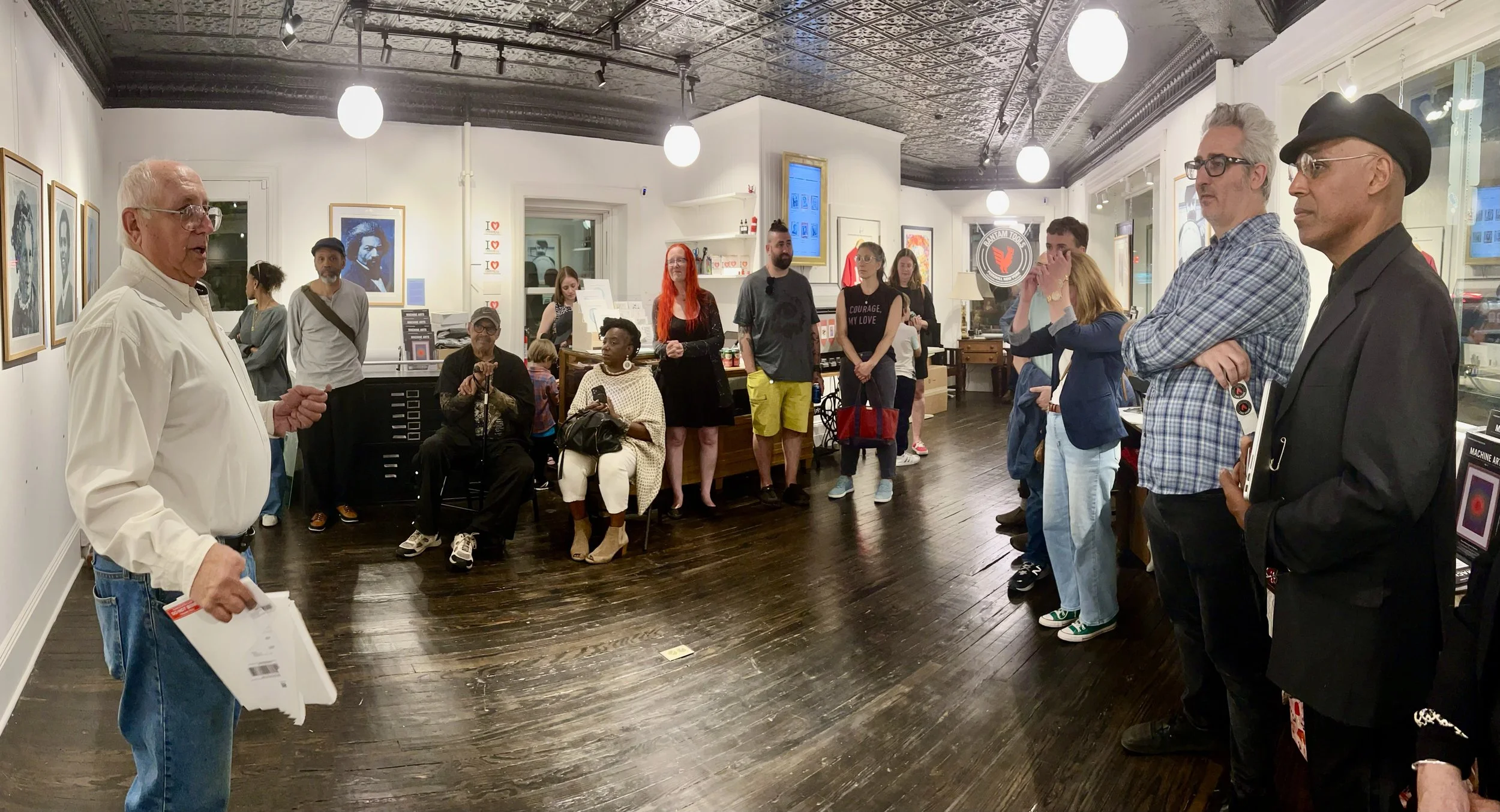
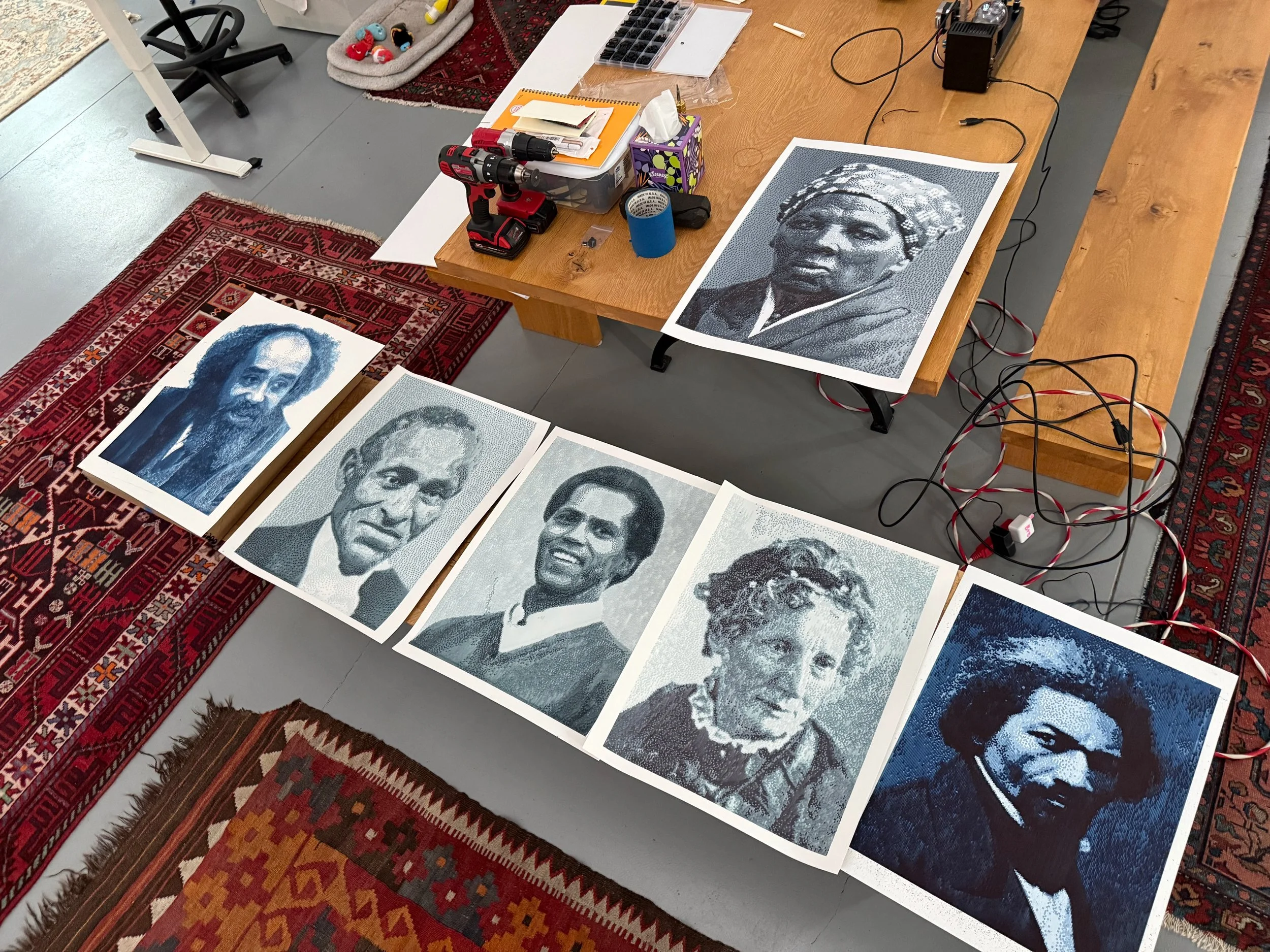
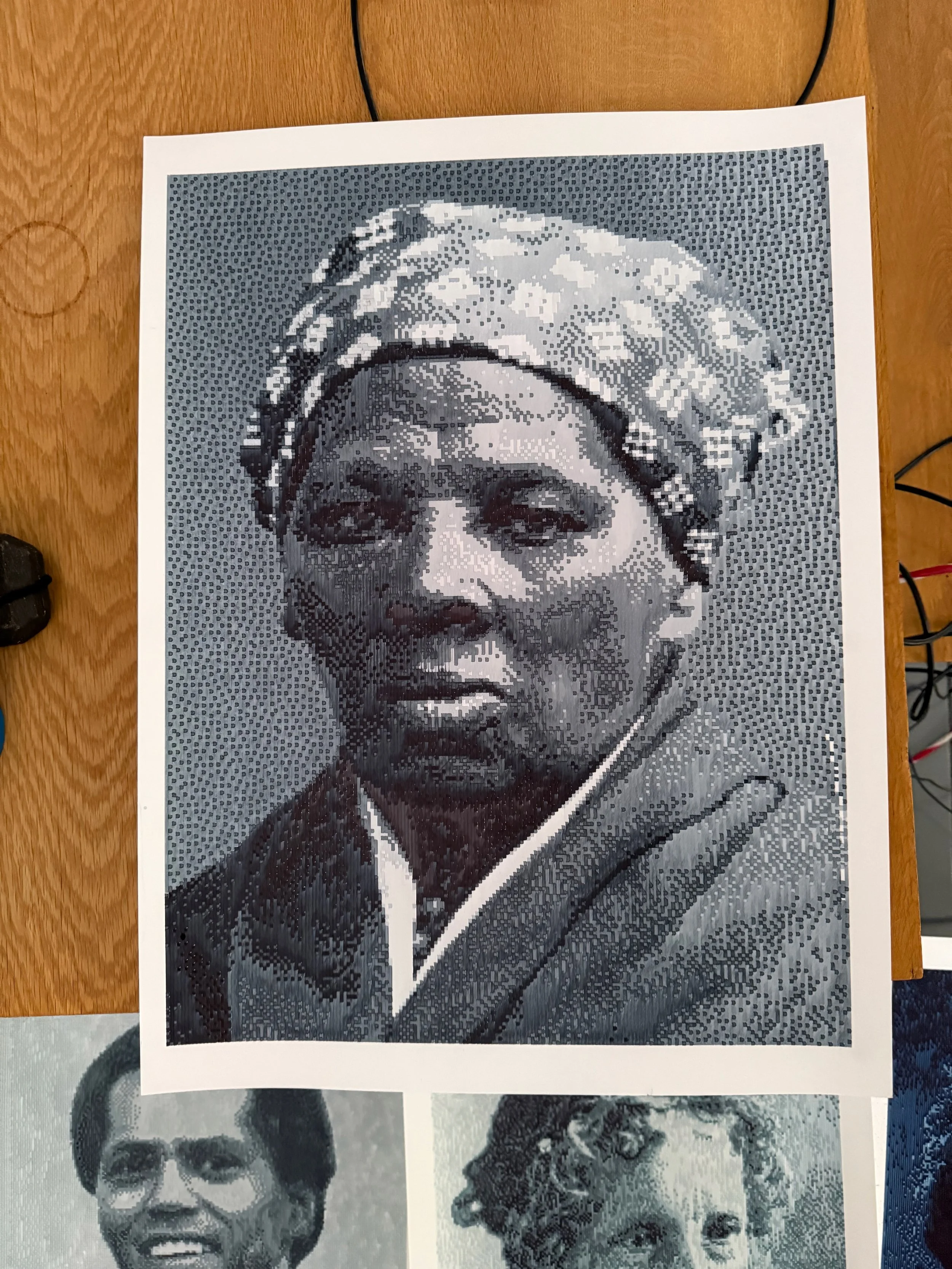
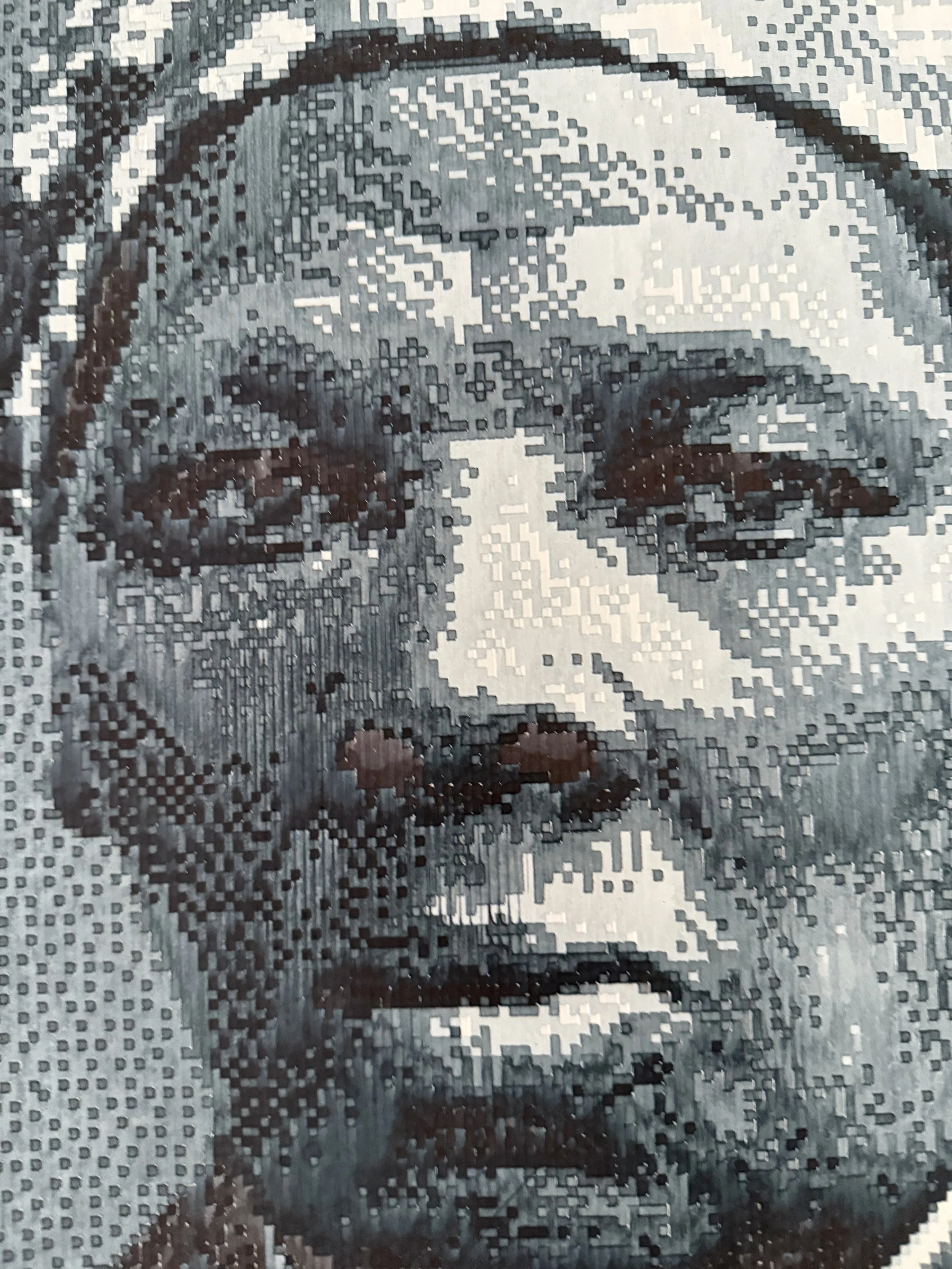
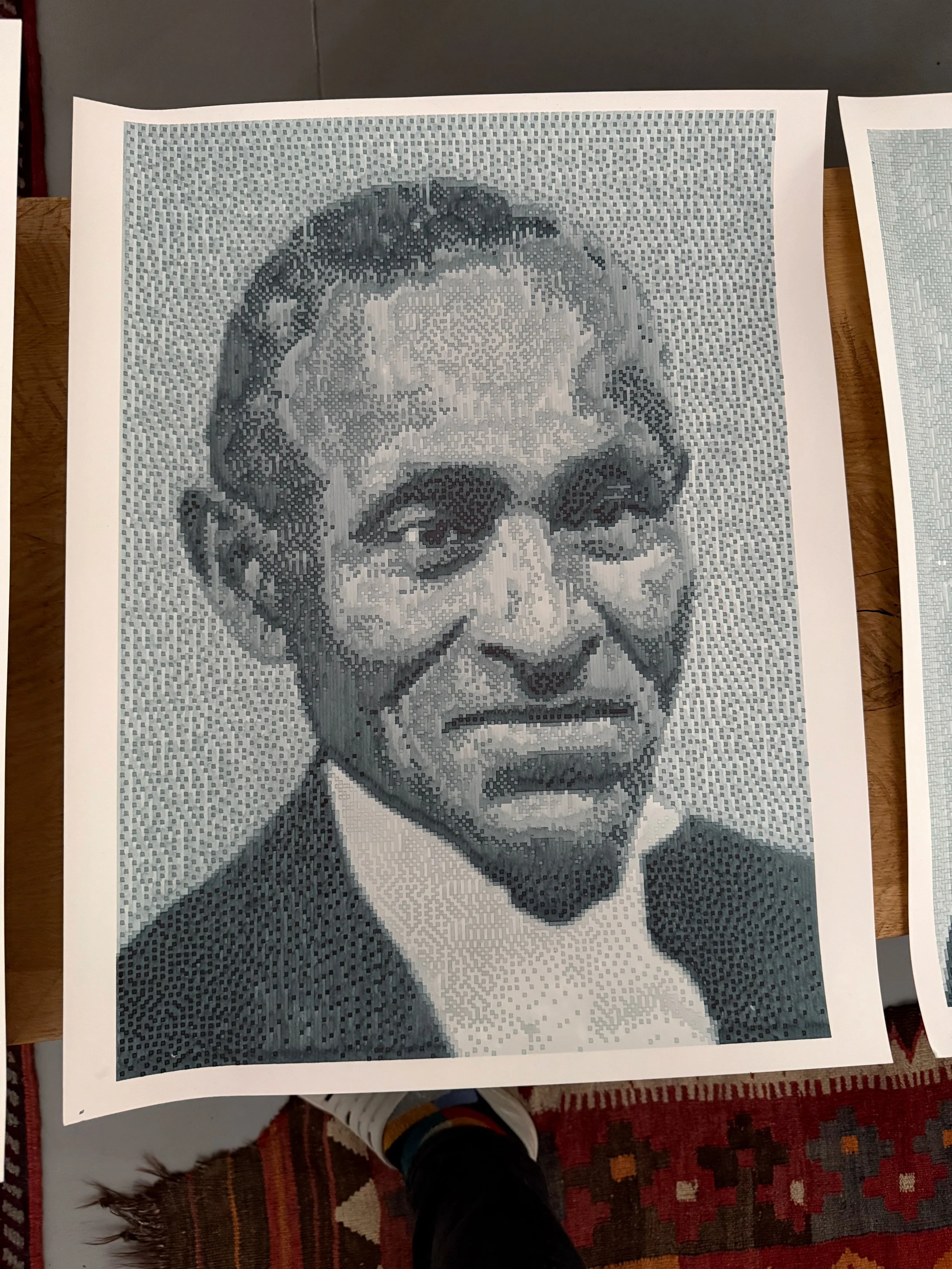
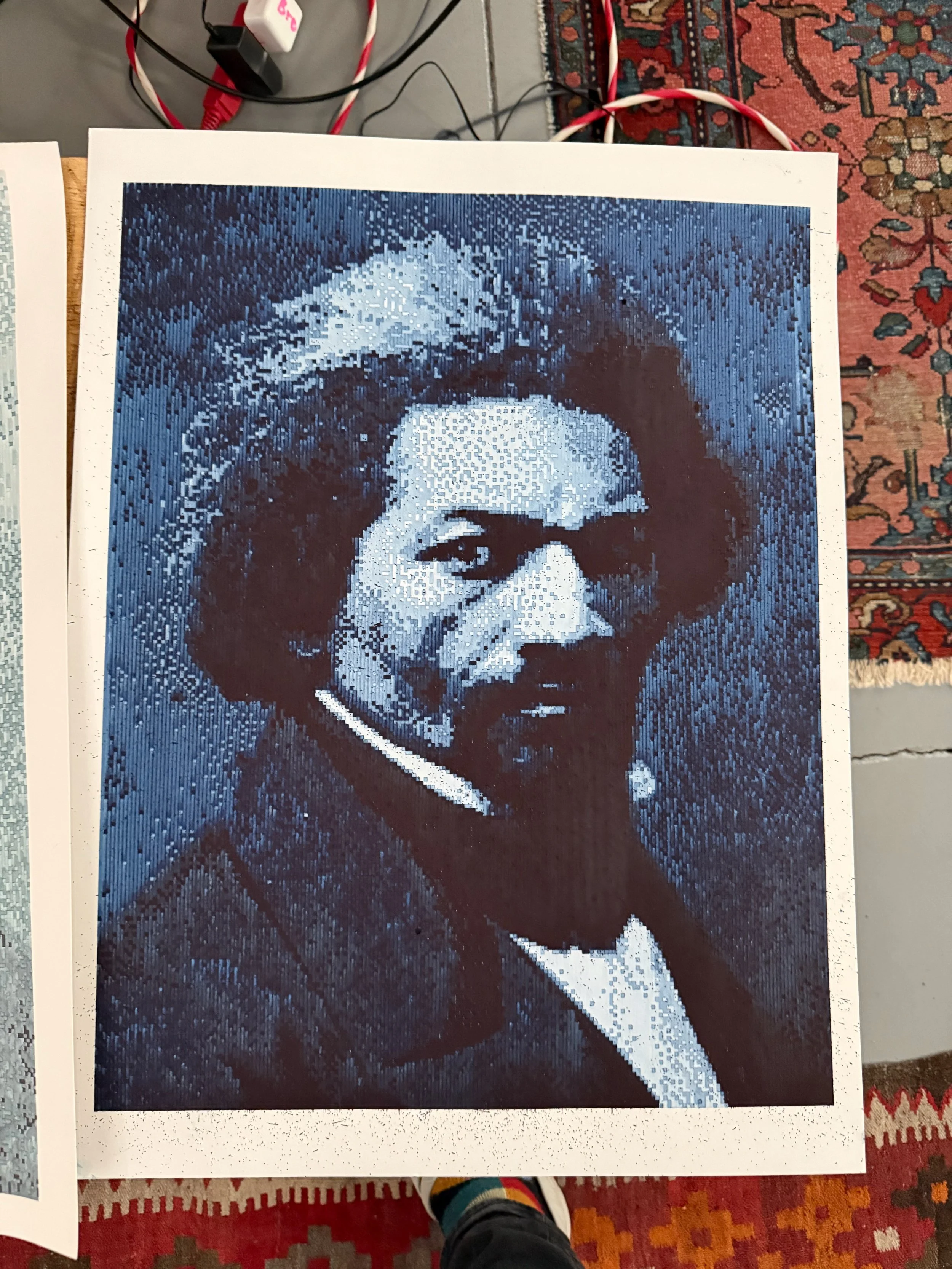
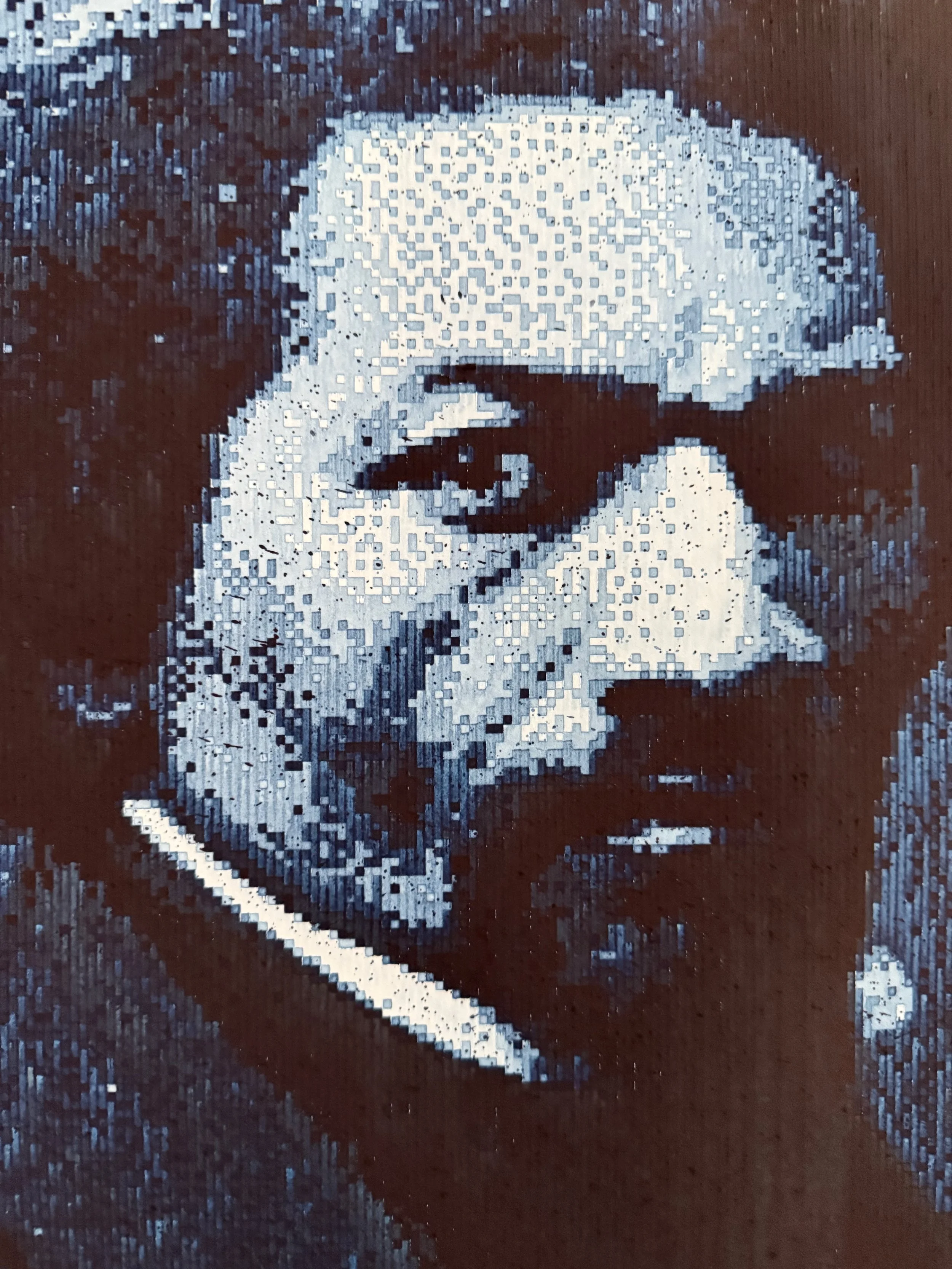
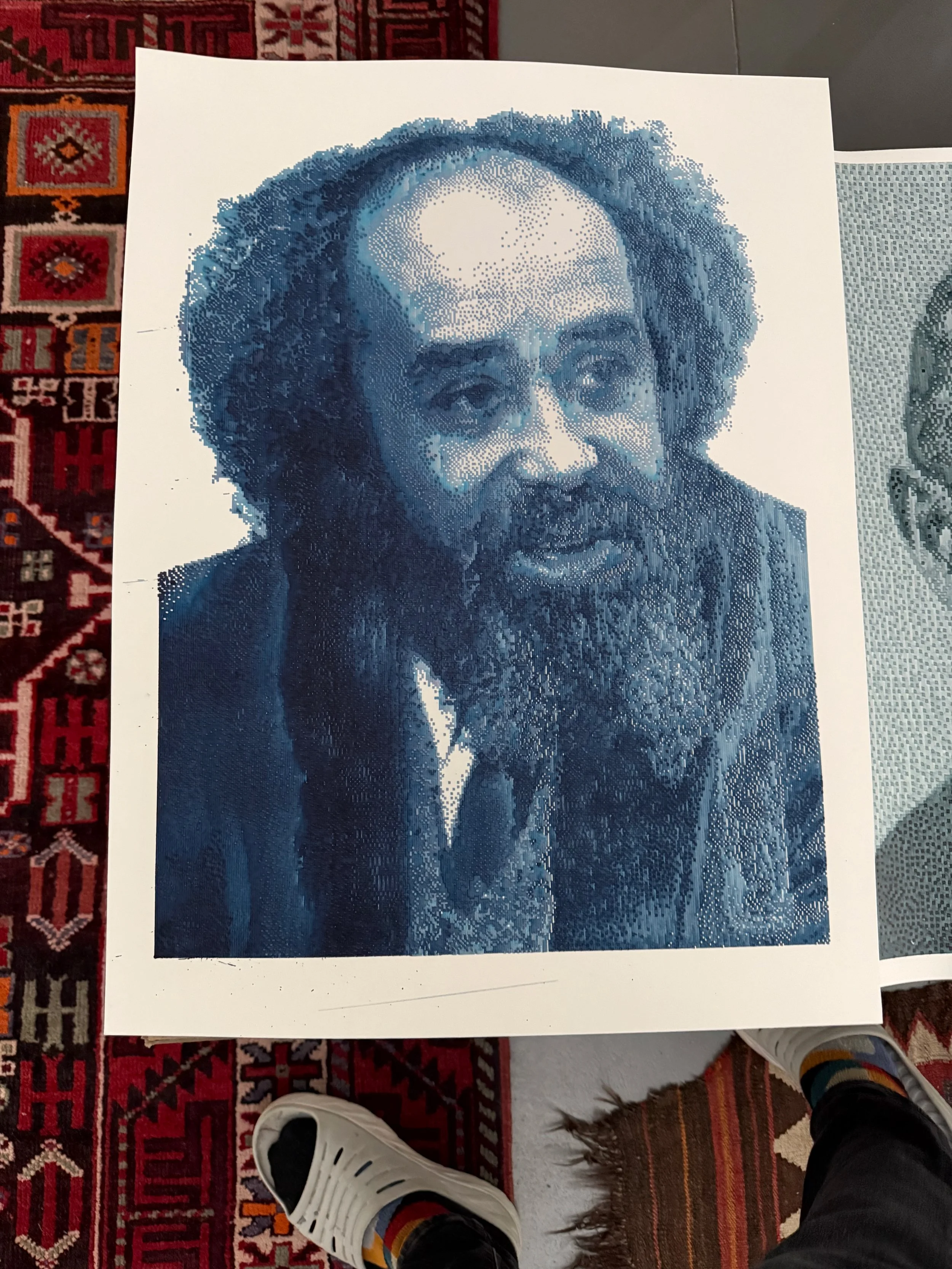
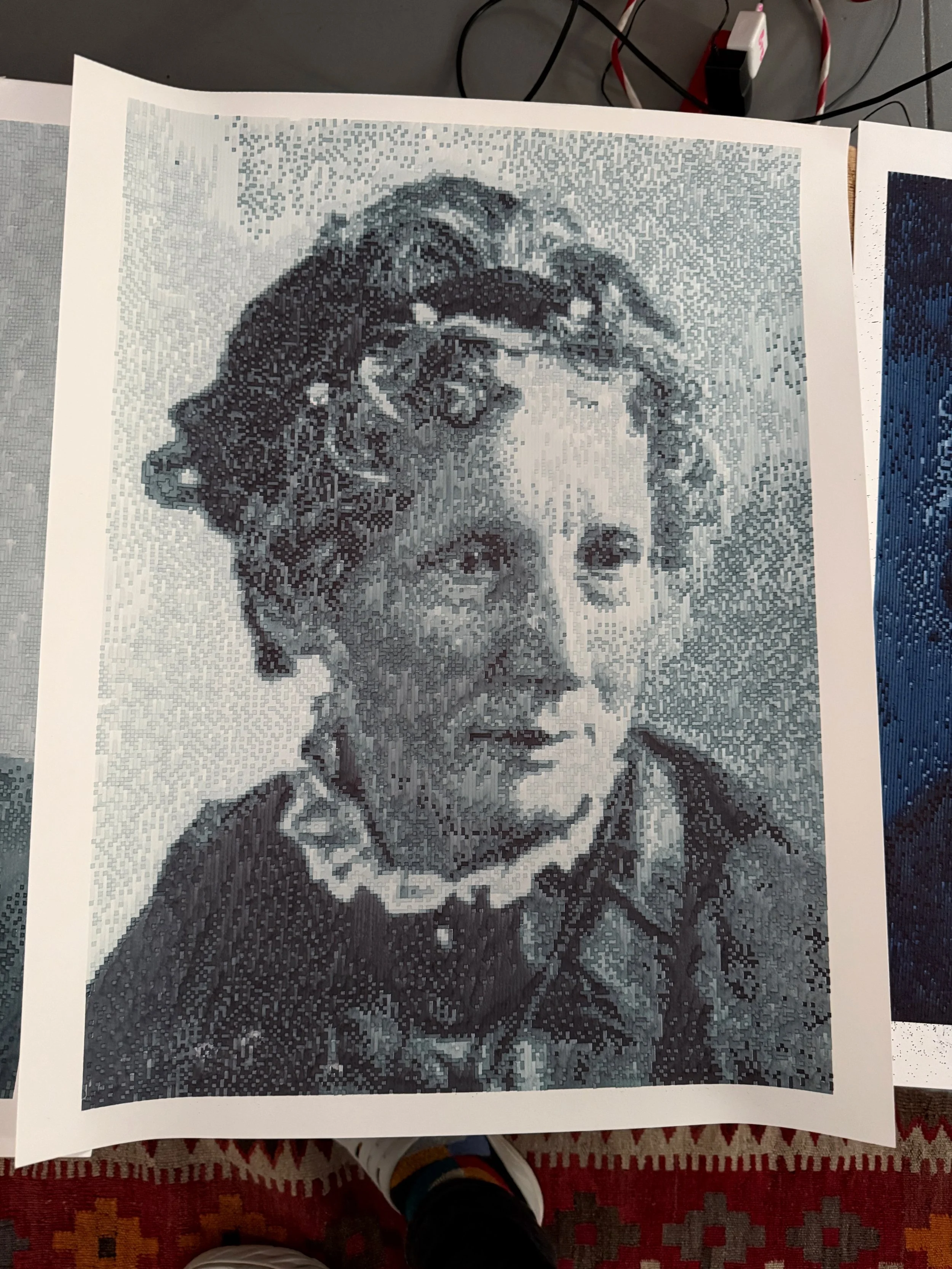
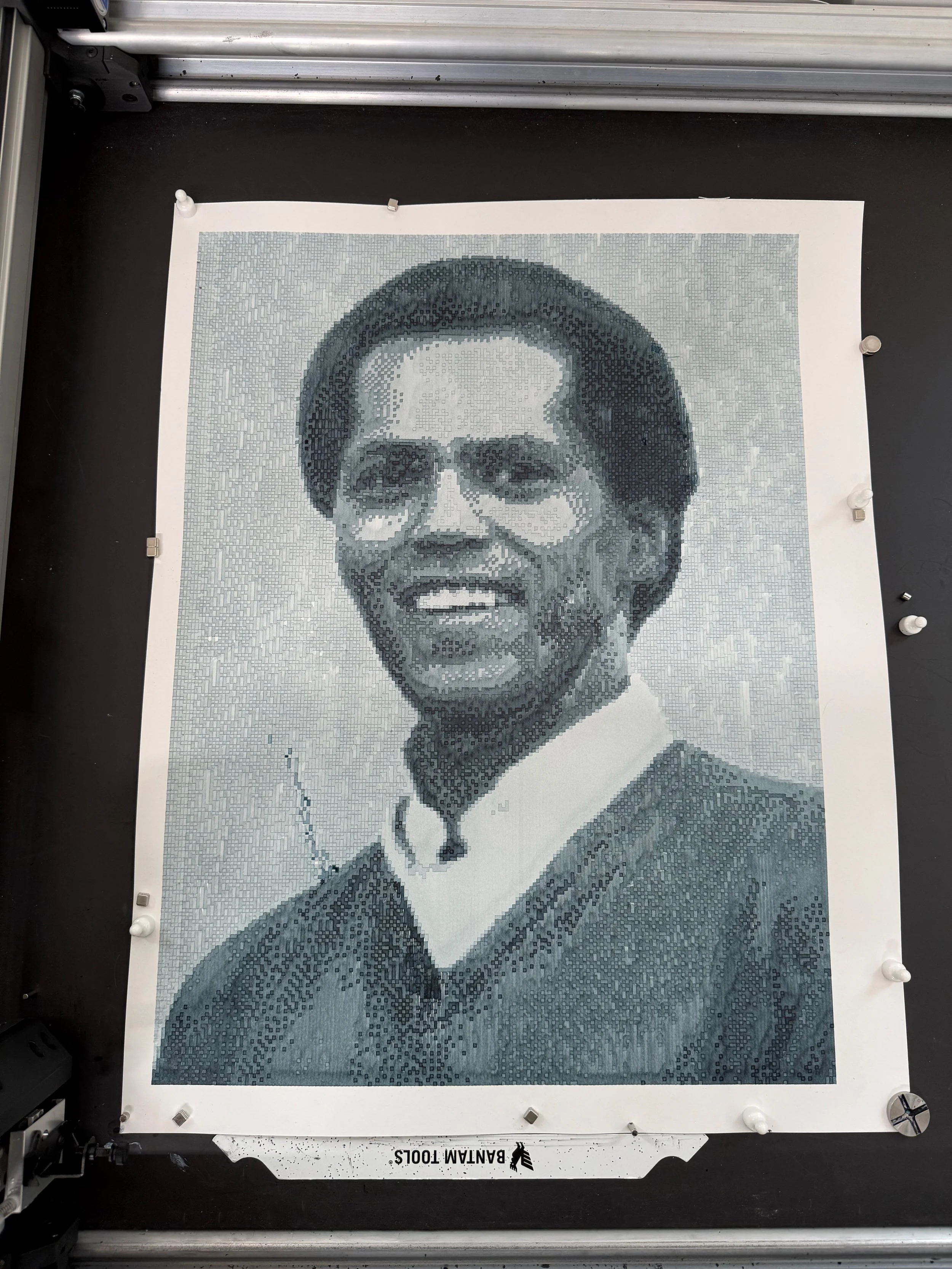
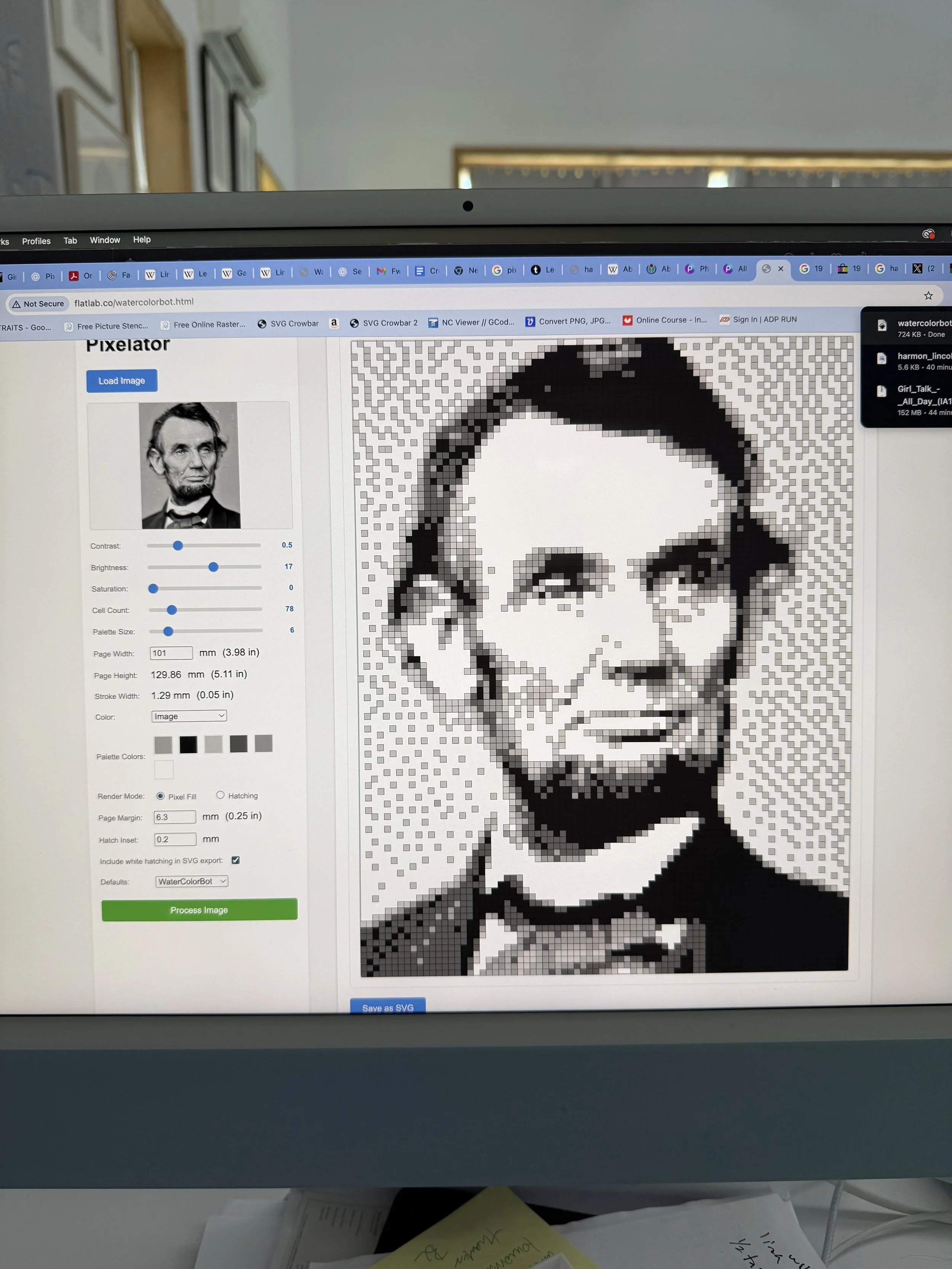
Inspired by Shepard Fairey’s mural in DC, I came home and decided to make portraits and feature people in my community who have done good for others.  I researched these folks and made portraits using a parallel pen and a software program I made to create the portraits from old photographs.  We had an opening and the descendants of Harriet and Hawley Greene showed up along with many activists and changemakers who are alive and doing their best to protect others.

Abraham Lincoln (1809–1865), the 16th President of the United States, is best remembered for leading the nation through the Civil War, preserving the Union, and issuing the Emancipation Proclamation that set slavery on the path to abolition. He also delivered timeless words like the Gettysburg Address, which reframed the war as a struggle for freedom and equality.
Lincoln’s story has a direct tie to Peekskill: on February 19, 1861, he stopped here on his way to Washington for his inauguration, giving a speech that forever connected Peekskill to his historic journey.
By today’s standards, however, Lincoln was a flawed figure—he did not fully embrace racial equality, supported colonization schemes for freed African Americans, curtailed civil liberties during the war, and authorized policies that harmed Native peoples. His greatness lies in his leadership during a crisis, but his limitations remind us that even heroes are complicated.

Harriet Tubman (1822–1913) was born into slavery in Maryland and escaped to freedom in 1849. She became one of the most courageous leaders of the Underground Railroad, personally guiding dozens of enslaved people to freedom and helping hundreds more find safe passage. During the Civil War, she served the Union Army as a nurse, scout, and even led an armed raid that freed more than 700 enslaved people—making her one of the few women to lead U.S. military operations. After the war, she also fought for women’s suffrage, working alongside leading suffragists.
Tubman had a connection to Peekskill, where she visited friends and spoke publicly about the abolitionist cause. Her presence in the Hudson Valley inspired many in the fight for justice and freedom.
By today’s standards, Tubman is rightly celebrated as a hero, though in her own lifetime she was often denied recognition, respect, and pay for her wartime service. Her life reminds us that greatness often comes from resilience in the face of deep injustice.

W. Haywood Burns (1940–1996) was a lifelong champion of civil rights and social justice whose journey began in Peekskill. As a teenager, he successfully fought to desegregate the Peekskill Pool, launching a career devoted to equality.
Burns went on to become one of the nation’s leading civil rights lawyers. He worked with the NAACP Legal Defense Fund, advised the Rev. Dr. Martin Luther King Jr. on the Poor People’s Campaign, and served as general counsel to the National Conference of Black Lawyers. He later became dean of CUNY Law School, shaping a generation of lawyers committed to public service and human rights.
Peekskill was where his voice for justice was first heard, setting the stage for a career dedicated to dismantling systemic racism and building a more equitable world.

Richard E. Jackson Jr. (b. 1945) made history in 1984 when he became the first Black mayor in New York State, right here in Peekskill. A mathematics teacher and community leader, Jackson’s election broke barriers and inspired future generations of leaders across the Hudson Valley and beyond.
After his time as mayor, Jackson continued to serve New York, including as Commissioner of Motor Vehicles, where he brought reforms to state services. His leadership in Peekskill showed how local politics could spark statewide change, cementing the city’s role as a place of progress.

Harriet Beecher Stowe (1811–1896), author of the groundbreaking novel Uncle Tom’s Cabin, helped galvanize the abolitionist movement with her vivid portrayal of the horrors of slavery. Her writing reached millions and gave moral urgency to the cause of abolition, influencing public opinion across the United States and abroad.
Though she lived primarily in Connecticut, Stowe’s family had deep ties to Peekskill through her brother, Henry Ward Beecher, a famed preacher who spoke here and spread abolitionist ideas.
Stowe’s literary voice echoed across the nation, and her family’s connection to Peekskill rooted the city within the wider network of 19th-century reform.

Frederick Douglass (c.1818–1895) was born into slavery in Maryland and escaped to freedom in 1838. He became one of the most powerful voices of the 19th century—an orator, writer, publisher, and activist who championed the abolition of slavery, the rights of African Americans, and the cause of women’s suffrage. His autobiography, Narrative of the Life of Frederick Douglass, remains one of the most influential accounts of slavery ever written.
Douglass spoke in Peekskill several times, addressing packed audiences at local churches and halls. His presence connected the Hudson Valley directly to the national abolitionist movement, inspiring local communities to join the struggle for freedom.
By today’s standards, Douglass is rightly celebrated as a visionary, though in his own lifetime he was often dismissed or attacked by those unwilling to confront the truths he spoke. His legacy is a testament to the power of words to change hearts, minds, and history.

Hawley and Harriet Green were African American landowners in Peekskill in the mid-19th century whose home became part of the Underground Railroad. Hawley, a local barber, and Harriet, his wife, provided shelter and support for those escaping slavery, risking their livelihoods and safety to aid freedom seekers.
Their quiet courage and steadfast commitment made Peekskill a sanctuary on the long road to freedom. The Greens’ legacy is a reminder that Peekskill was not just a witness to history, but an active participant in the fight for human dignity. (No photo of Harriet Green available)

Pete Seeger (1919–2014) was a folk singer, songwriter, and activist whose music gave voice to social movements for peace, civil rights, labor, and the environment. Songs like If I Had a Hammer, Turn! Turn! Turn!, and Where Have All the Flowers Gone? became anthems of change, uniting people through melody and message.
Seeger lived for decades on the banks of the Hudson River near Peekskill and became one of the region’s most beloved cultural figures. He co-founded the environmental group Clearwater and launched the annual Clearwater Festival, using music to rally support for cleaning the Hudson. His connection to Peekskill was also personal: he performed here often, and in 1949 he famously faced a violent backlash when he sang at a benefit concert in Peekskill, an event that became a turning point in the nation’s struggle against racism and intolerance.
By today’s standards, Seeger is celebrated as both an artist and activist, though in his own lifetime he was blacklisted and silenced for his political beliefs. His legacy shows how music, rooted in community, can become a force for justice.

Paul Robeson (1898–1976) was an internationally renowned singer, actor, and activist who used his talents to champion civil rights, labor rights, and global peace. A gifted athlete and scholar as well as a performer, Robeson broke barriers on stage and screen while insisting that art must serve justice.
Robeson’s connection to Peekskill is unforgettable. In 1949, he headlined benefit concerts for the Civil Rights Congress just outside the city. Racist mobs violently attacked the events, and the so-called “Peekskill Riots” drew national attention to the persistence of racism and intolerance in the North. Despite the violence, Robeson refused to back down, embodying courage in the face of hate.
By today’s standards, Robeson is celebrated as a visionary who stood boldly for human dignity, though in his own lifetime he was blacklisted, surveilled, and silenced for his political beliefs. His legacy reminds us that speaking truth to power often comes at great personal cost.

George Pataki (b. 1945) was born and raised in Peekskill, where he attended Peekskill High School before rising from local politics to become the 53rd Governor of New York. Starting as mayor of Peekskill (1981–1984), he moved on to the State Assembly and Senate, and in 1994 he was elected governor, serving three terms until 2006. Pataki is remembered for his calm leadership after the attacks of September 11, 2001, when he became a steadying presence for both New York and the nation. He also expanded environmental protections with landmark land preservation programs, enacted major tax cuts, and began reforms of New York’s harsh Rockefeller Drug Laws. A moderate Republican, Pataki was an early advocate for gay rights within his party, supporting anti-discrimination protections and pushing for greater equality at a time when such positions were politically risky.
Pataki stands as an icon of political achievement from Peekskill, a reminder that the city has produced leaders who shaped both state and national history.

Rosina Bonavita (1925–1966), a Peekskill native, became a symbol of women’s contributions to the American war effort during World War II. Known as one of the real-life inspirations for “Rosie the Riveter,” Bonavita worked at the General Motors plant in Tarrytown, NY, where she and thousands of other women took on industrial jobs traditionally reserved for men. Her work represented the strength and determination of a generation of women who stepped forward to keep the nation’s factories running while soldiers fought overseas.

Though her name is less well known than the iconic “We Can Do It!” poster, Bonavita’s story is rooted in Peekskill’s history, reminding us that the image of Rosie the Riveter was built on the real lives of women like her. By today’s standards, she stands as both an icon of gender equality and a symbol of how ordinary women reshaped the workforce and opened new doors for future generations.